LearningMate
LearningMate is an AI tutor and learning-support layer for a university learning platform. It sits on top of the existing LMS: inside lecture materials, students get quizzes and a mistake notebook, so professors can see what students actually understand.
How we changed direction
What we assumed
Professors struggle to make lecture materials.
What we heard
Six professors and the university's teaching center told us otherwise. Most already build on existing materials; what takes time is adapting them to their own students' level. The bigger burdens were not knowing what students understood until the midterm, grading written answers, and the end-of-term improvement (CQI) report.
What we changed
Quizzes and a mistake notebook now sit inside the lecture materials, so professors see where students struggle every week. The materials tool shifted from generating slides to pulling figures, tables, and key concepts out of papers, textbooks, and other lecture materials.
What professors told us
- A software professor: until the midterm, there is no real way to tell what students have understood.
- A senior professor: written exams show understanding best, but grading them for more than 100 students takes "a full week, and it's still hard," so they switched to short answers. If AI could grade against their scoring points, they would gladly go back.
- Another professor: if they could see all student results, an auto-drafted CQI report would be welcome, one that says "students found this hard, and this part didn't land."
As a sociology and psychology major, I treated the interviews like field research. We first reviewed research on how professors assess students, then interviewed professors one by one and adjusted our questions after each interview.
"Why not just use ChatGPT?"
A demo reviewer asked exactly this. My answer, which shaped the product: a general chatbot doesn't know the course. Ours answers from the syllabus, lecture materials, and attachments, follows how the professor wants students taught, and shows professors where students get stuck. To make professors trust it, I pushed for two things: a panel that shows exactly what information goes into the AI, and a second model that cross-checks AI-generated quizzes.
What I owned: the student question flow
- Answers grounded in the course. Answers come from the syllabus, lecture materials, and attachments, and are labeled when they come from the model's general knowledge instead.
- The professor's teaching style. Professors can set the tutor to ask Socratic follow-up questions instead of handing over answers, and to work through formulas step by step for engineering courses.
- Harder than expected. Even a strong model answered poorly at first. I restructured what we sent it into a fixed format that carried only what it needed, and the answers improved.
- How I tested it. I wrote 20 to 40 test questions for social science and humanities courses and checked every answer. My first engineering questions missed: engineering teammates and peers told me the terms were awkward translations from English and the questions were too basic. I rewrote them into questions real students would ask and tested again. I enjoyed this loop: each round, the answers got visibly better.
What I did as PM
- Helped set the scope. With the team and feedback from the teaching center, we focused on the professor side and limited where AI goes.
- Split the work among the four of us.
- Planned backward from the Dec 7 final presentation.
- Agreed on a team PR rule: tests, an independent review, then approval before merging. I reviewed AI agents' work against pass criteria before it was merged.
Other features I built, with AI agents
- Syllabus AI assistant: helps professors draft a syllabus and flags gaps before saving.
- CQI report helper: drafts the end-of-term improvement report from course data.
- Question collection: gathers student questions so professors can see them in one place.
- Mistake notebook and quiz review, connected to the learning AI.
- Professor dashboard for following each student's progress.
Screens
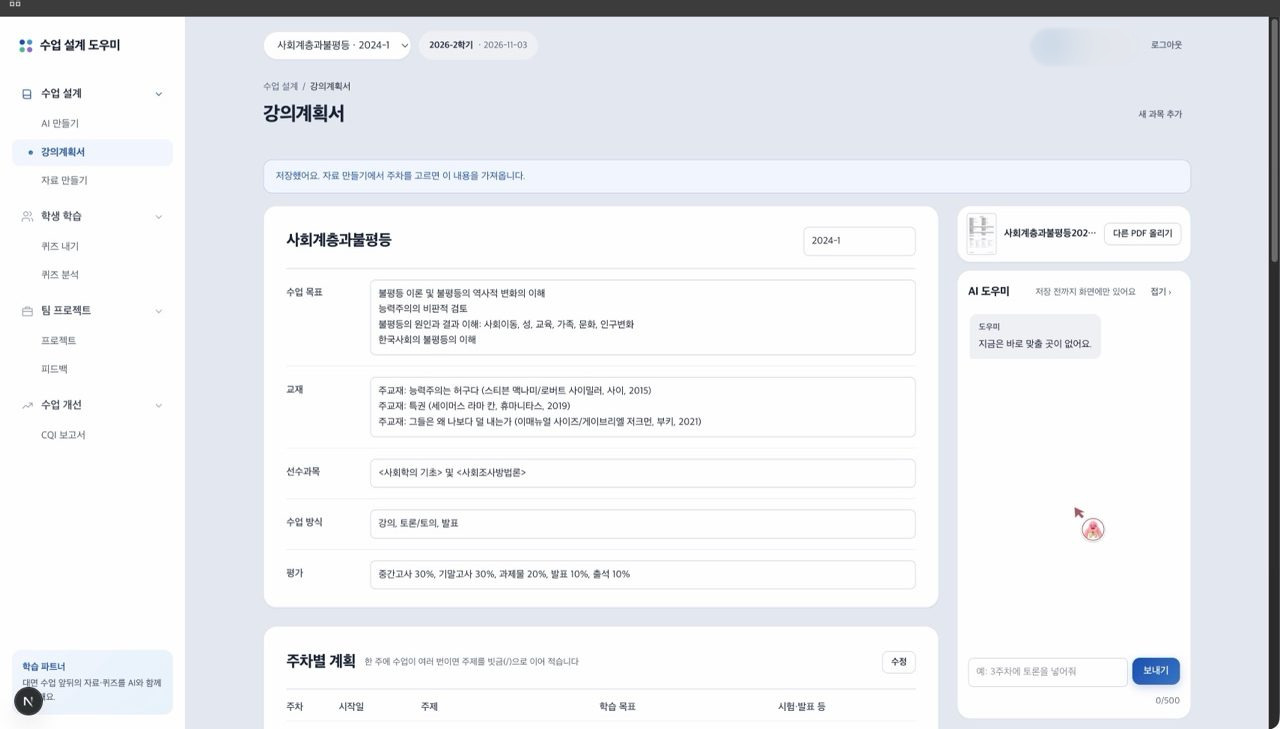
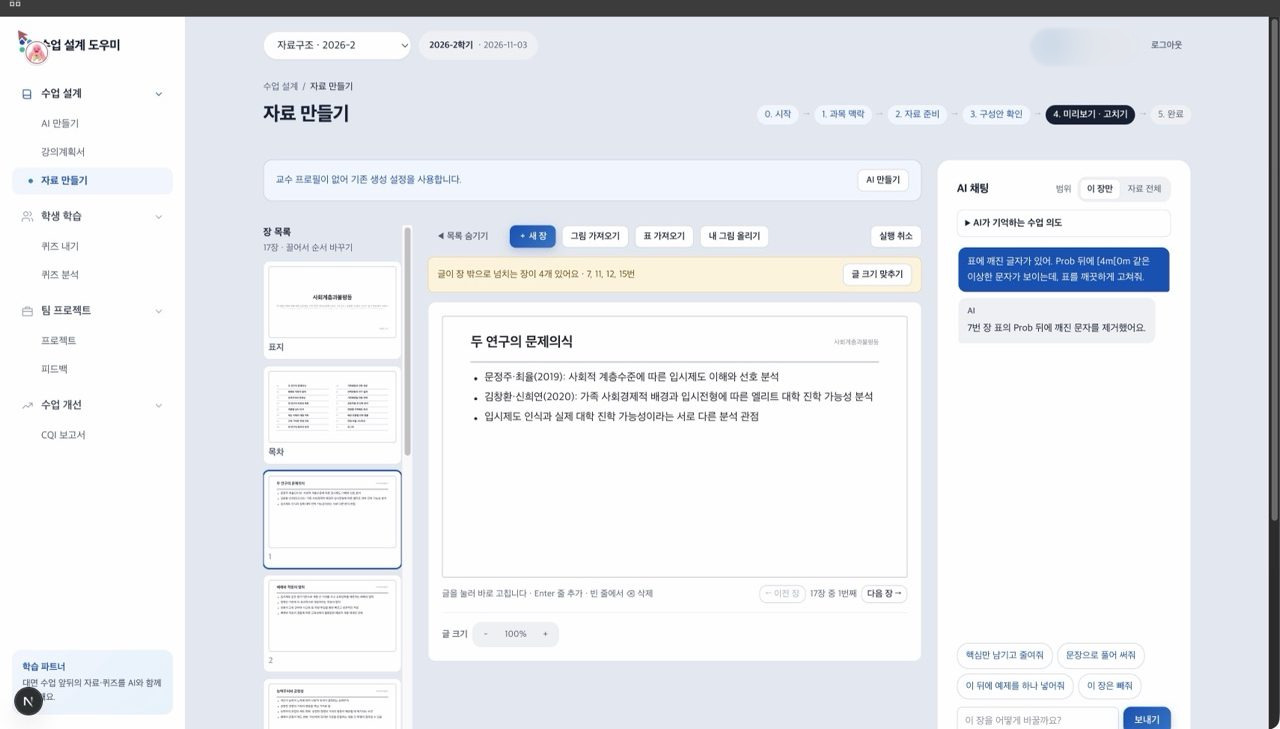
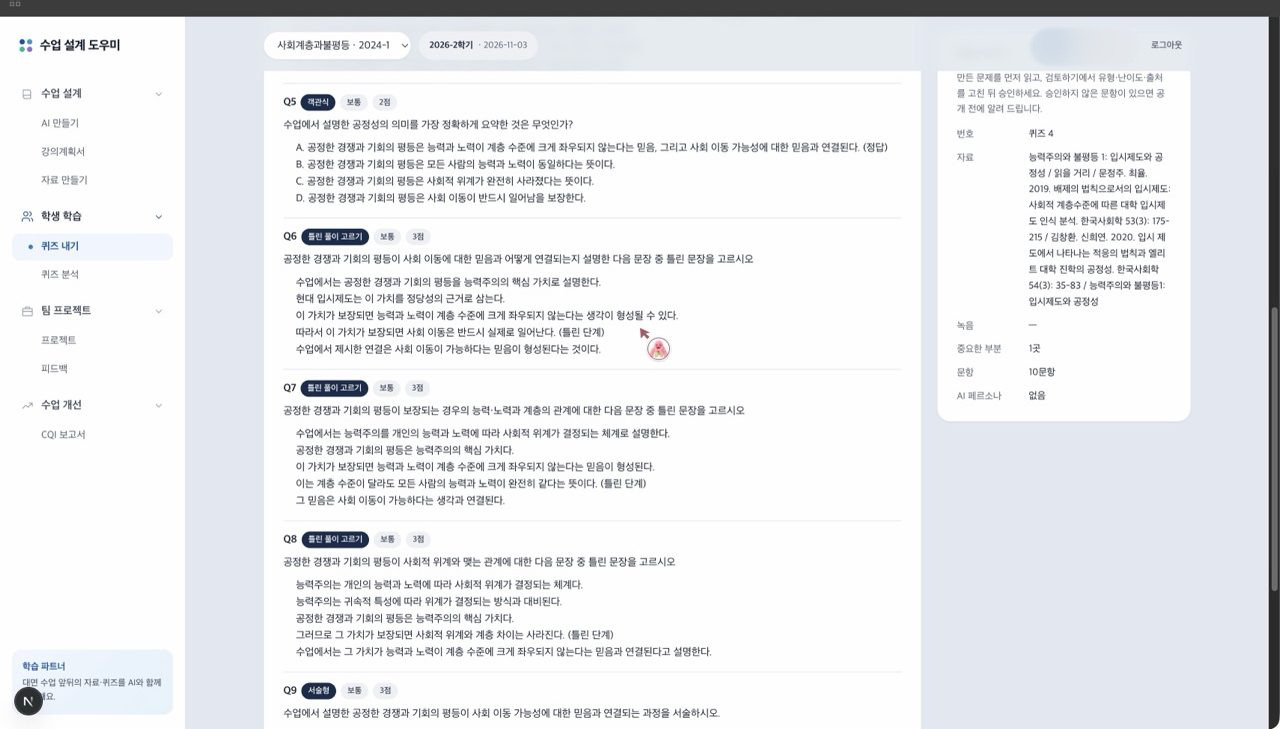
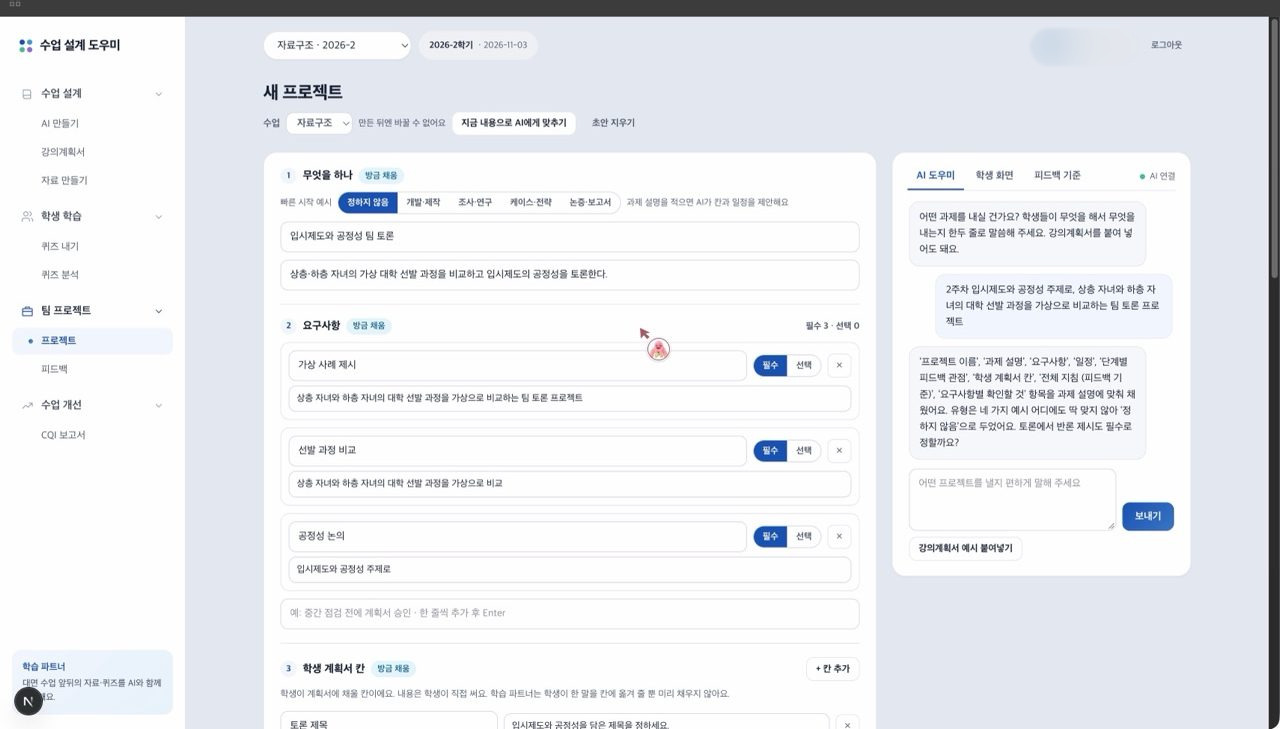
Professor-side screens, Korean interface. Early version from Nov 2026; the product has changed since. Student-side screens are coming soon.
Stack the team used
I work in this stack through AI coding agents, not as a full-time engineer.